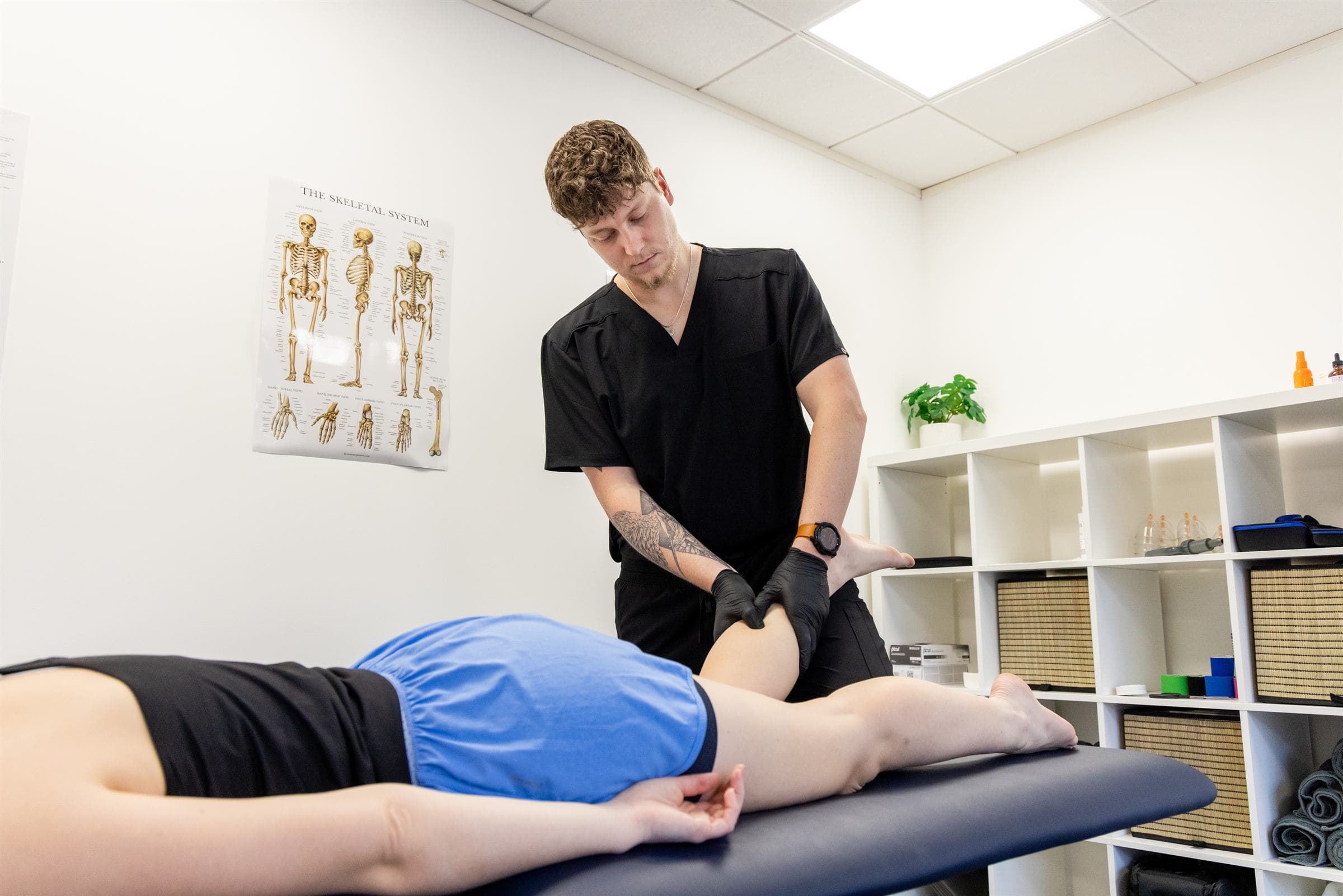
Hands-on leg massage on a treatment couch at Joint Initiative Physiotherapy in Norwich city centre
Deep tissue massage

Deep Tissue Massage in Norwich City Centre

Deep tissue massage uses slow, sustained pressure to work on muscles that feel persistently tight, heavy or knotted. At Joint Initiative it is delivered by a chartered physiotherapist, so the session is guided by an understanding of what sits beneath the tension. You don't need to play sport or have an injury to book.

£50
30 minute massage
£70
60 minute massage
7pm
Late finish Tuesday and Thursday

Deep tissue massage explained

What deep tissue massage is

Deep tissue massage is a firm, deliberate style of massage. Strokes are slow and pressure is held on tight areas long enough for the muscle to ease, instead of moving quickly over the surface. It is used to reduce the feeling of tension and stiffness and to help you move more comfortably.

  • Slow, sustained pressure applied with hands, forearms or elbows
  • Work concentrated on specific tight areas, not a full-body routine
  • Pressure adjusted throughout to what you find firm but tolerable
  • Some tenderness for a day or two afterwards is common and normal

Who it suits, including desk workers

Many people who book are not athletes. They sit at a desk or drive for much of the day and carry tightness across the neck, shoulders and back. With the clinic on Rose Lane, close to the railway station and Riverside, sessions fit easily around a working day in the city centre.

  • Neck and shoulder tightness linked to desk work or long hours at a screen
  • A stiff, aching upper or lower back that eases with movement
  • Persistent tension in the hips, glutes or legs from sitting or standing all day
  • Anyone who prefers firm, focused pressure to a light relaxation massage

When massage is not the right option

Massage is not suitable for every situation, and it may help symptoms without addressing why they keep returning. If your pain followed an injury, is getting worse, or comes with pins and needles, numbness or weakness, a physiotherapy assessment is the better starting point. Matt will tell you if he thinks that applies.

  • Avoid deep pressure over a recent injury, open wound or skin infection
  • Tell us if you take blood-thinning medication or bruise easily
  • Do not book if you have, or might have, a blood clot in a leg
  • If you are unwell with a fever, rearrange your appointment

What happens in a massage session

  1. 1

    Choose 30 or 60 minutes

    Book online or by phone. 30 minutes suits one area, such as the neck and shoulders. 60 minutes allows time for the back and a second region.

  2. 2

    A short conversation first

    Matt asks where you feel tight, what your days involve, and about your health and any medication, so the session is safe and well targeted.

  3. 3

    Slow, focused pressure

    Treatment builds gradually from lighter strokes to deeper, held pressure on the tightest areas. You can ask for more or less at any point.

  4. 4

    Simple advice to take away

    You leave knowing what was found, with one or two things to try, such as a stretch or a change to your desk routine.

Massage from a chartered physiotherapist

  • Massage at the clinic is carried out by an HCPC registered chartered physiotherapist.
  • If something in the session suggests a problem that needs assessing, you are already with a clinician who can explain your options, including referral back to your GP.
  • Deep tissue massage sits alongside sports massage, cupping and instrument-assisted soft tissue mobilisation at the clinic, so the approach can be matched to you.

Treatment is delivered by an HCPC registered chartered physiotherapist. Meet Matt Joslin, BSc (Hons) MCSP.

Prices and where to find us

  • Deep Tissue & Sports Massage30 minutes£50
  • Deep Tissue & Sports Massage60 minutes£70

The Union Building, 51-59 Rose Lane, Norwich, NR1 1BY

Monday, Wednesday and Friday 9am to 5pm. Tuesday and Thursday 11am to 7pm.

See all prices and book

Common questions

Do I need an injury to book a deep tissue massage?

No. Most people book deep tissue massage for general tightness, not for an injury. It suits desk workers, drivers, manual workers and anyone whose muscles feel persistently tense. If you do have an injury or pain you are worried about, say so when you book, as a physiotherapy assessment may be a more useful first appointment.

Should I book 30 or 60 minutes of deep tissue massage?

Book 30 minutes (£50) if the tension is mainly in one area, such as your neck and shoulders or your lower back. Choose 60 minutes (£70) if you want more than one region covered, or if the tightness is long-standing and you would like time for slower, more thorough work without rushing between areas.

What should I wear for a deep tissue massage?

Wear comfortable clothing that is easy to remove from the area being treated. For back, neck and shoulder work you will usually be asked to undress to the waist. For hips or legs, shorts are helpful.

Can deep tissue massage be combined with physiotherapy?

Yes. Massage and physiotherapy are booked as separate appointments, and many people use both. A common pattern is a physiotherapy assessment first to understand what is driving the problem, followed by massage sessions alongside a home exercise programme. Because the same chartered physiotherapist provides both, what is found in one session informs the other.

Book your appointment in Norwich city centre

Choose a time online, or call the clinic if you would like to talk it through first.