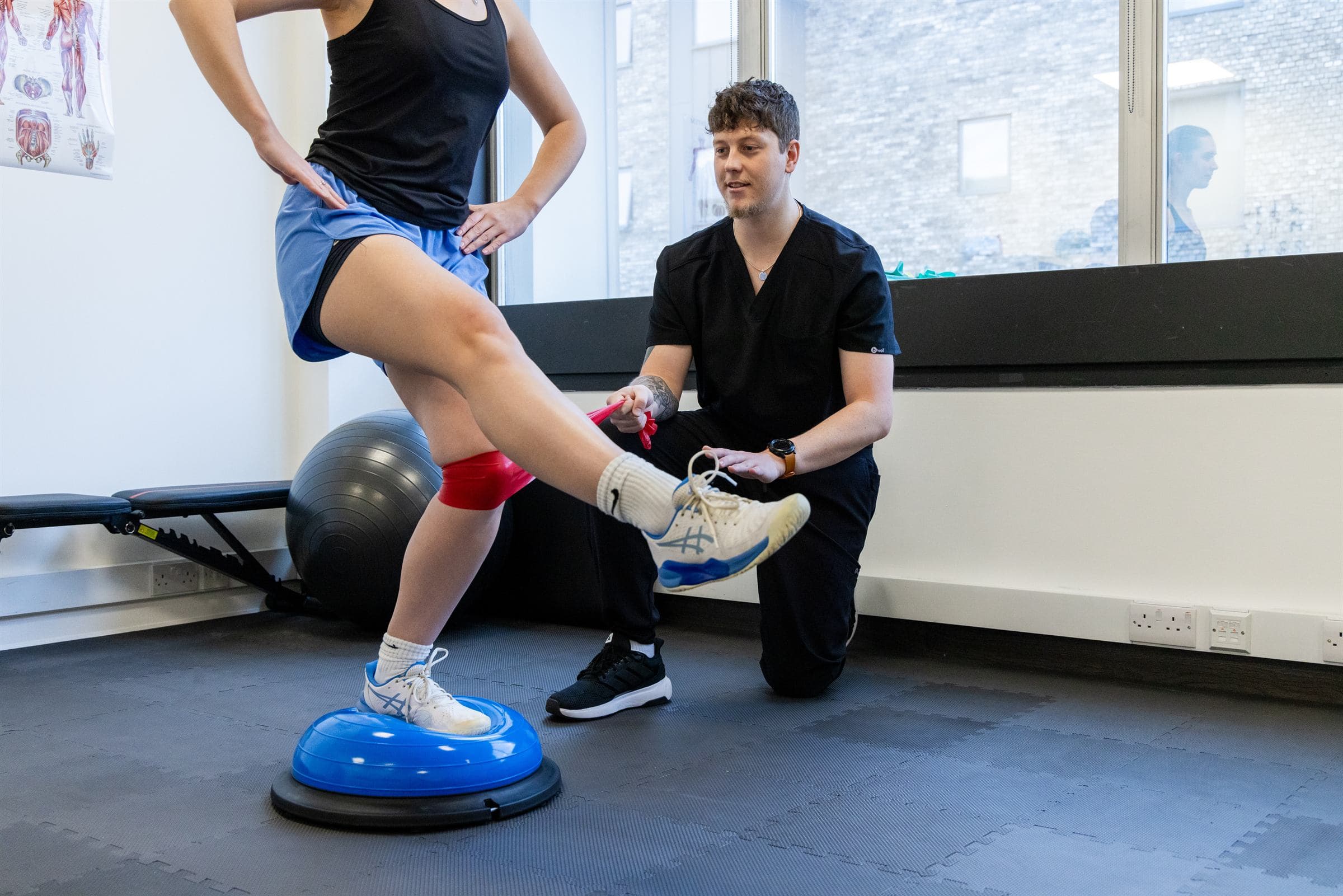
Single-leg balance exercise supervised by a physiotherapist at Joint Initiative Physiotherapy in Norwich
Sports injury physiotherapy

Sports Physiotherapy in Norwich

Sports physiotherapy at Joint Initiative is for anyone whose injury is getting in the way of the sport or training they care about. You are assessed and treated by Matt Joslin, a chartered physiotherapist who has delivered on-field care and rehabilitation for a professional football team. The aim is a clear picture of what is injured, and a staged plan for getting back to playing.

60 min
Initial sports injury assessment
MCSP
Chartered physiotherapist
NR1
Norwich city centre clinic

What sports physiotherapy covers

Injuries we see from sport and training

Most sports injuries fall into two groups: sudden ones, such as a rolled ankle or a pulled hamstring, and gradual ones that build up when training load outpaces what the tissue is ready for. Both respond better to an early, accurate assessment than to weeks of guessing. Sports physiotherapy looks at the injured area and at the demands of your sport together.

  • Ligament sprains, including ankle, knee and wrist sprains
  • Muscle strains and tears, such as hamstring, calf, quad and groin injuries
  • Tendon problems that flare with running, jumping, gripping or throwing
  • Recurring niggles that settle with rest and return as soon as you train

Assessment, treatment and taping

Your first appointment is a 60 minute assessment covering how the injury happened, your training history and what you need to get back to. Matt then examines the area, tests strength and movement, and starts treatment in the same session. If anything suggests the injury needs a scan or a medical opinion, he will advise you to see your GP or seek further investigation.

  • Movement analysis of the actions your sport asks of you
  • Manual therapy, including joint mobilisation and soft tissue work
  • Kinesio and sports taping to support an area as you return to activity
  • A personalised exercise programme that progresses as you improve

Return-to-sport planning and screening

Feeling better in daily life is not the same as being ready for a match, a race or a heavy session. A return-to-sport plan sets out stages, from early loading through to sport-specific drills, with checks at each stage before you move on. Sports screening is also available if you are not injured and want to find weak links before a season or event.

  • Staged progressions for running, change of direction, jumping or lifting
  • Strength and control targets agreed before each step up in training
  • Sports screening and injury prevention work for individuals
  • Advice on training load, recovery and what to tell your coach

From injury to match fitness

  1. 1

    Tell us how it happened

    We go through the injury, your sport, position or event, weekly training and any deadline you are working towards, such as a fixture or a race.

  2. 2

    Assess the injury and the movement

    Matt examines the injured area, tests strength and range, and watches the movements your sport relies on. Bring trainers for lower-limb problems.

  3. 3

    Treat and start loading

    Treatment begins in the first session, with hands-on work, taping where useful, and exercises pitched at what the injury can tolerate now.

  4. 4

    Build back to sport in stages

    Follow-up sessions progress your programme through agreed stages until you are back in full training, with advice on reducing the risk of a repeat.

Why athletes choose Joint Initiative

  • Matt Joslin has worked with a professional football team, delivering on-field care and rehabilitation, and has treated athletes at ultra-marathons and tennis tournaments.
  • He is an HCPC registered chartered physiotherapist (BSc Hons, MCSP) who plays football and tennis himself, so he understands what it means to be kept out of your sport.
  • The clinic is at The Union Building on Rose Lane in Norwich city centre, with appointments until 7pm on Tuesdays and Thursdays to fit around work and training.

Treatment is delivered by an HCPC registered chartered physiotherapist. Meet Matt Joslin, BSc (Hons) MCSP.

Prices and where to find us

  • Initial Physiotherapy Assessment60 minutes£90
  • Follow-up Physiotherapy Session30 minutes£55

The Union Building, 51-59 Rose Lane, Norwich, NR1 1BY

Monday, Wednesday and Friday 9am to 5pm. Tuesday and Thursday 11am to 7pm.

See all prices and book

Common questions

Do I need to be a competitive athlete to book sports physiotherapy?

No. Sports physiotherapy is for anyone injured through exercise, from five-a-side players and gym members to club runners and weekend tennis players. The approach is the same whatever your level: understand the injury, treat it, and rebuild the strength and movement your activity demands. Your goals shape the plan, whether that is a league season or a weekly class.

How soon after a sports injury should I see a physio?

You can book as soon as you are able to travel comfortably, and you don't need a GP referral. An early assessment helps you understand what is injured and how much to do in the first days. If you cannot put weight through a limb, have severe swelling or think a bone may be broken, go to A&E or call NHS 111 first.

Can I keep training while I have sports physiotherapy?

Often yes, in a modified form. Complete rest is rarely the best option for long, so Matt will usually suggest what you can keep doing, what to reduce and what to pause for now. That might mean swapping running for cycling, or training the uninjured areas. The plan is adjusted at each session as the injury responds.

What should I wear to a sports physio appointment?

Wear or bring clothing that lets the injured area be seen and moved, such as shorts for a leg injury or a vest top for a shoulder. Bring the trainers you train in for lower-limb problems. If you have scan results, medical notes or a training log, bring those too, as they help build a fuller picture.

Book your appointment in Norwich city centre

Choose a time online, or call the clinic if you would like to talk it through first.