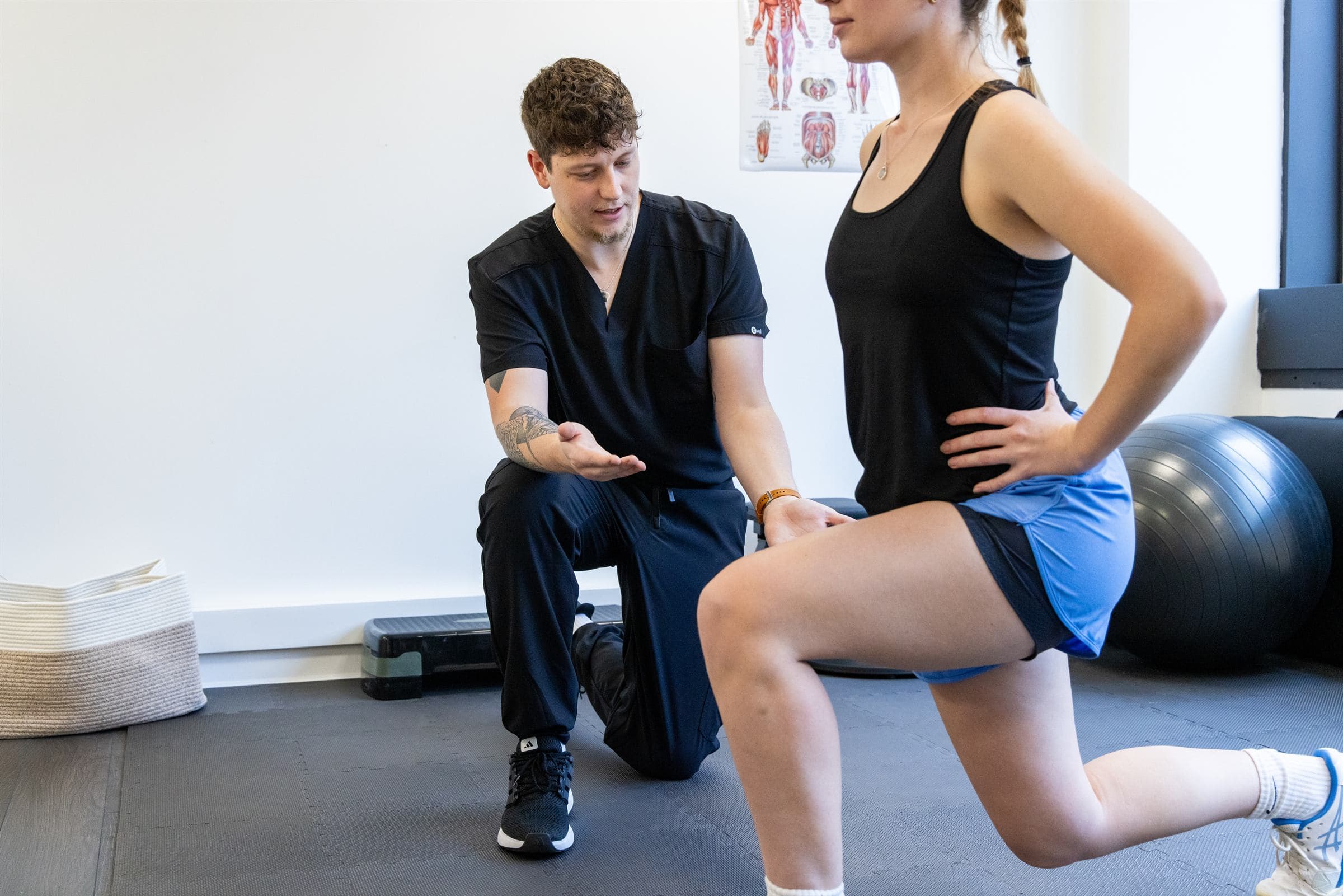
Physiotherapist assessing a patient's lunge at Joint Initiative Physiotherapy, Rose Lane, Norwich
Knee injuries

Physio for Knee Pain in Norwich

Whether your knee gave way on the pitch, aches on the stairs or has stiffened gradually over the years, the first job is to find out which structure is responsible. At Joint Initiative Physiotherapy in Norwich city centre, Matt Joslin tests the ligaments, cartilage and kneecap, then sets out rehabilitation with clear markers for progress.

BSc (Hons)
Physiotherapy degree
24 hrs
Notice to reschedule
Online
Direct booking available

Knee problems from ligament injuries to arthritis

What tends to go wrong with knees

The knee is a hinge that depends on four main ligaments for stability, two menisci for cushioning and the thigh muscles for control. Injuries usually follow a twist or impact, while kneecap pain and osteoarthritis tend to build up gradually.

  • Anterior cruciate ligament (ACL) injuries, often a twist or awkward landing with a pop, rapid swelling and a knee that feels unstable
  • Meniscus tears, causing pain along the joint line, swelling, and sometimes catching or locking when the knee bends and straightens
  • Patellofemoral pain around or behind the kneecap, brought on by stairs, squatting, kneeling or sitting for long periods with knees bent
  • Knee osteoarthritis, with stiffness after rest, aching when walking or climbing stairs and occasional swelling

Tests used to examine a knee

After asking exactly how the problem began and whether the knee swells, locks or gives way, Matt examines the joint on the couch and then on your feet. Bring trainers and shorts so that squatting and step tests can be done properly.

  • Checking for fluid in the joint and measuring how far the knee bends and straightens compared with the other side
  • Gently pulling the shin forwards and stressing the knee sideways to feel whether the cruciate and collateral ligaments are holding firm
  • Pressing along the joint line and bending the knee with rotation to see whether the meniscus is sensitive
  • Watching a squat, a single-leg step-down and, where suitable, a hop to see how the knee, hip and foot control load

Knee rehabilitation and when to look elsewhere

Strengthening the quadriceps, hamstrings and hip muscles is the foundation for almost every knee condition, with the detail varying by diagnosis. Many meniscus problems and arthritic knees are managed without surgery, and some ACL injuries are too, depending on your goals.

  • Progressive strength work such as squats, step-ups and hamstring exercises, measured against your uninjured leg
  • For kneecap pain, hip and thigh strengthening with temporary changes to training load, plus taping where it helps
  • For osteoarthritis, regular exercise and activity pacing in line with UK guidance, aiming for easier walking and stairs
  • A suspected ligament rupture or a knee that locks and will not straighten needs a medical opinion, and Matt will direct you to your GP for onward referral

Knee rehab from swelling to full strength

  1. 1

    Establish how it happened

    Matt asks about the moment of injury or the gradual build-up, whether the knee swelled quickly, and what you want to return to, from stairs at work to the Run Norwich 10K.

  2. 2

    Examine ligaments, cartilage and kneecap

    Stability, joint line tenderness, swelling and movement are checked on the couch, followed by squat and step tests to see how the leg copes under load.

  3. 3

    Restore movement and control swelling

    Early sessions aim to get the knee fully straight, improve bend and wake up the quadriceps, with guidance on how much walking and activity is sensible.

  4. 4

    Strengthen, then test before sport

    Loading is increased over the following weeks and, for sporting knees, strength and hop performance are compared side to side before running, twisting and matches resume.

Experienced hands for knee injuries

  • Matt Joslin has delivered on-field care and rehabilitation with a professional football team, a setting where knee ligament injuries are common.
  • He holds a BSc (Hons) in Physiotherapy, is a member of the Chartered Society of Physiotherapy and is registered with the HCPC.
  • The clinic offers post-surgical rehabilitation, so your rehabilitation can continue here if your knee does need an operation.

Treatment is delivered by an HCPC registered chartered physiotherapist. Meet Matt Joslin, BSc (Hons) MCSP.

Prices and where to find us

  • Initial Physiotherapy Assessment60 minutes£90
  • Follow-up Physiotherapy Session30 minutes£55

The Union Building, 51-59 Rose Lane, Norwich, NR1 1BY

Monday, Wednesday and Friday 9am to 5pm. Tuesday and Thursday 11am to 7pm.

See all prices and book

Common questions

Do I need surgery for a torn meniscus in my knee?

Not always. Many meniscus tears, particularly the gradual wear-related type seen from middle age, are managed with exercise-based rehabilitation and settle without an operation. Surgery is more likely to be considered if the knee locks or will not fully straighten. Matt will assess your knee and advise you to see your GP if a surgical opinion looks appropriate.

Can physio help my knee after an ACL injury?

Yes, physiotherapy is central to ACL care whether or not you have surgery. Early work reduces swelling and restores movement and thigh strength. Some people then cope well without reconstruction, while others, often those returning to pivoting sports, choose an operation. That decision is made with a specialist. Rehabilitation after a reconstruction commonly takes nine months or more.

Why does the front of my knee hurt on stairs?

Pain at the front of the knee on stairs is commonly patellofemoral pain, where the joint behind the kneecap becomes sensitive to load. It often follows a rise in activity or reduced thigh and hip strength. It is not usually a sign of damage. Strengthening the hip and thigh muscles and adjusting activity for a while is the standard approach.

Is it a bad sign if my arthritic knee clicks or crunches?

Usually not. Clicking and crunching noises are very common in knees with and without osteoarthritis, and on their own they are not a reliable sign that the joint is getting worse. Pain, swelling and how well you can move matter more. If the noise comes with locking or the knee giving way, have it assessed.

Book your appointment in Norwich city centre

Choose a time online, or call the clinic if you would like to talk it through first.